Property in Orihuela Costa — a coastal strip that is not its own municipality
Orihuela Costa is not a municipality — its town hall is 30 km inland. How La Zenia, Cabo Roig, Villamartín and Punta Prima actually differ from each other. We list 29 properties in Orihuela Costa, at a median of €559 000 — about €4 640 per square metre.
A buyer in Orihuela Costa pays their taxes to the municipality of Orihuela, whose town hall stands 30 kilometres inland — a genuinely different place, with a cathedral, an old town and almost nothing but Spanish spoken. The coast itself is a roughly 16-kilometre strip at the southern end of the Costa Blanca, between Torrevieja and Pilar de la Horadada, and it is not a municipality of its own: no mayor, no council.
There is no centre either. Instead there is a run of named areas — La Zenia, Playa Flamenca, Cabo Roig, Punta Prima, Villamartín, Campoamor — built up from the 1970s onwards and differing from one another more than the map suggests. Those are what a buyer actually chooses between.
These figures describe our own listings, not the whole local market — our selection carries more new builds than the area average. Medians are calculated from sale listings and refresh nightly.
What the place is actually like
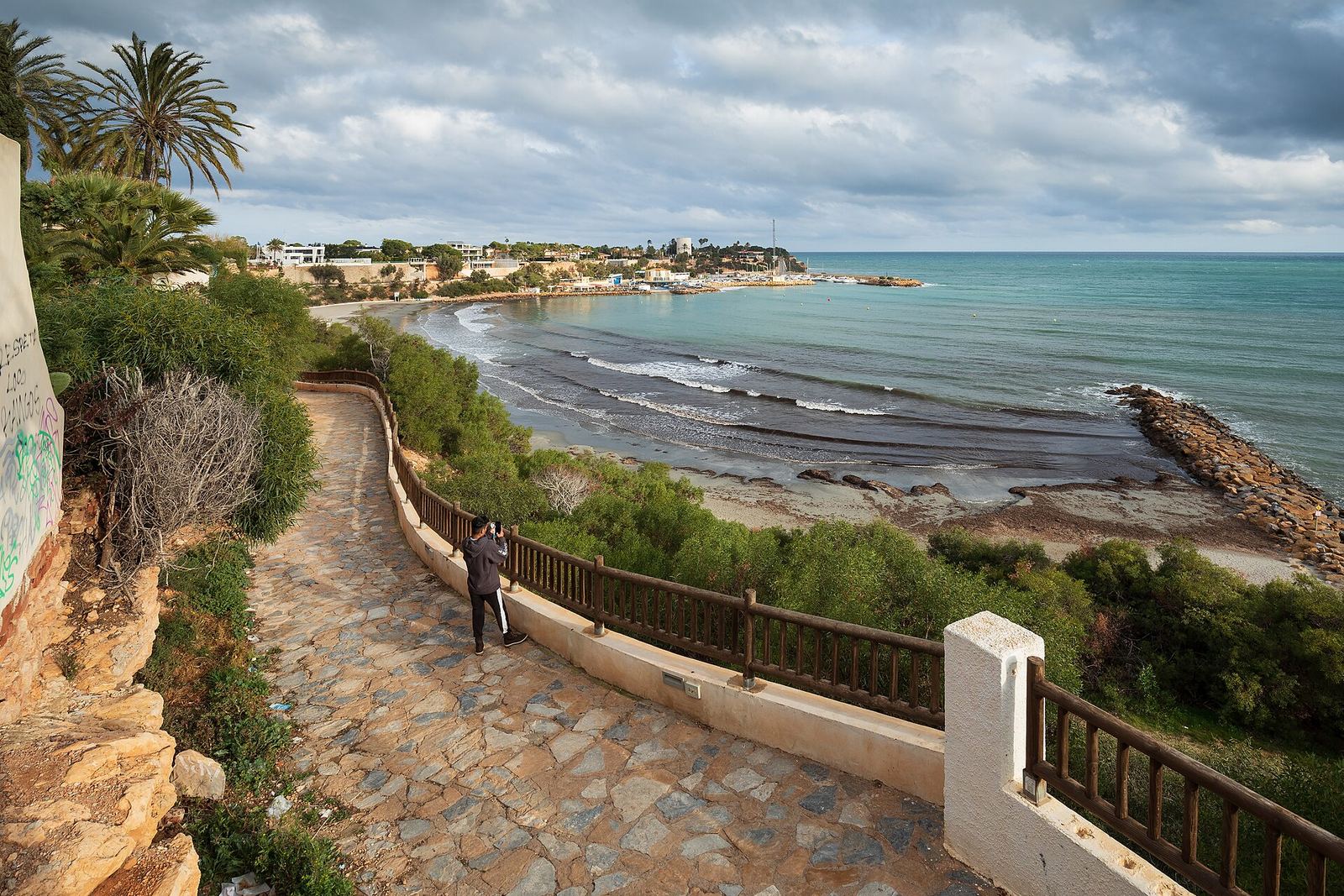
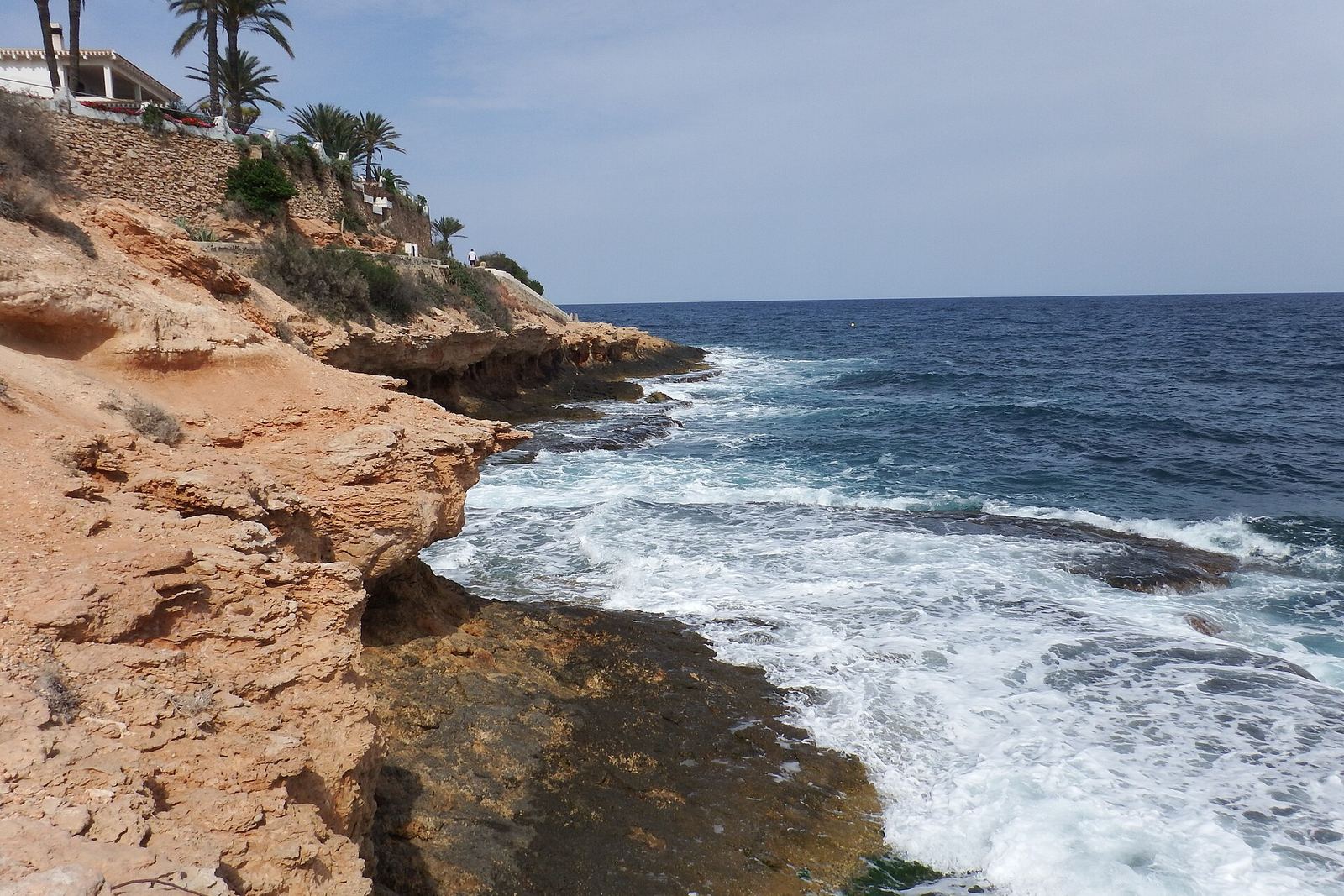
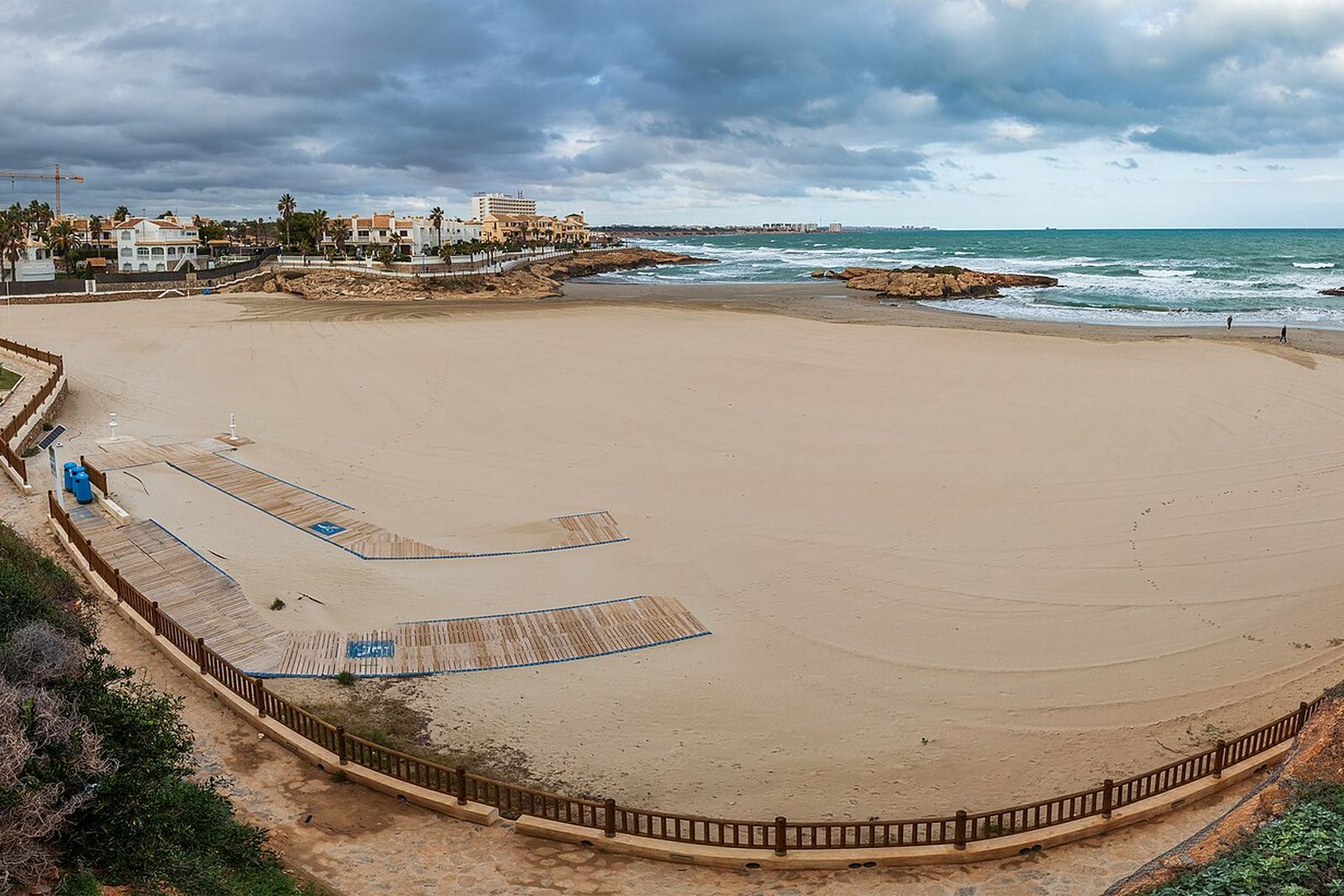
The shoreline is not one long stretch of sand but a dozen-odd small coves (calas) separated by low rocky headlands. In 2025 Orihuela's coast held ten Blue Flags, the best score in the province — among them Cala Bosque at La Zenia, Cala Capitán at Cabo Roig and La Glea at Campoamor. The climate is semi-arid: around 260 mm of rain a year, and a sea running from about 16 °C in winter to 26 °C in summer.
One road, the N-332, runs the length of the strip and every area branches off it; the AP-7 toll motorway is reached at exit 763. There is no railway on the coast. The shared centre such as it is opened in 2012: La Zenia Boulevard, an open-air mall of more than 150 shops, the largest in the province, with IKEA, Primark and Zara inside. Shop and restaurant signs in La Zenia and Cabo Roig are as often in English as in Spanish.
North to south. Punta Prima (1969) begins right on the Torrevieja boundary, is quieter and greener than the commercial core, and its beach has a wheelchair lift down to the sand. Playa Flamenca is one of the largest, split into I and II: dense apartment blocks, its own secondary school IES Playa Flamenca, a Saturday street market — and in August the busiest end of the strip. La Zenia, with the Boulevard and two Blue Flag coves, is the closest thing to a shared centre. Cabo Roig sits on the clifftop above Cala Capitán and La Caleta, with a restaurant-and-bar strip and a small Club Náutico.
Villamartín grew from 1972 around its golf course, is itself made up of smaller names — Las Filipinas, El Presidente, Blue Lagoon — and is predominantly Northern European. Next to it is Los Dolses with its primary school, CEIP Los Dolses. Dehesa de Campoamor is the most expensive end of the coast: a 19th-century estate that belonged to the poet and politician Ramón de Campoamor and took his name after his death in 1901, now built around Real Club de Golf Campoamor (1988) and the yacht club. Aguamarina is small and deliberately low-key, beside a protected flora microreserve and a fossil beach whose marine remains are dated to roughly 125,000 years old.
All of these are inside the municipality of Orihuela. The exception is Mil Palmeras at the far south: most of the built-up area falls under Pilar de la Horadada, even though its beach counts towards Orihuela's Blue Flag tally. Check which municipality a plot there is in before you buy.
On 1 January 2024 the register counted 26,122 residents; for the same year local reporting has also given 27,929 — the disagreement is not about the direction of travel but about where exactly the coast's boundary runs. The real number is higher: winter water consumption has been used to suggest around 45,000, and local estimates put the August peak at 60,000–80,000.
Across the whole municipality of Orihuela (85,674 people in 2024), 32% of residents held foreign nationality, from 121 countries, with Britons the largest group (9,681), followed by Morocco and Ukraine. Because inland Orihuela city is almost entirely Spanish, essentially all of that population lives on the coast; local sources put several areas above half foreign-born, but no official figure measuring the coast alone has been published.
The property market and letting out
Idealista's price index put the area at €3,042/m² in June 2026, 6.8% up on a year earlier; the readings in between — about €2,852/m² in August 2025 and €2,933/m² in November — point to a steady climb rather than a jump. What is mostly for sale is two- and three-bedroom apartments and semi-detached bungalows in gated developments (Playa Flamenca, La Zenia), plus townhouses and villas on the golf resorts (Villamartín, Campoamor). New-build activity is heavy in several still-developing pockets.
Short-term letting requires a VUT registration: Orihuela town hall first issues an urban-compatibility certificate tied to the property's cadastral reference, and only then does the Generalitat issue a five-year tourism-registry number. The stricter Decreto-ley 9/2024 has applied since 8 August 2024; from 2025 a let in a residential building also needs the owners' community's approval, and letting through a portal needs a national NRU number.
Which municipality, and where the town hall is
Orihuela Costa is the coastal part of the municipality of Orihuela: some 16 kilometres of coast whose administrative centre sits in Orihuela city, 30 kilometres inland. The coast itself has no mayor or council of its own — planning, infrastructure and budget decisions are taken in Orihuela, which is also where the old town, the cathedral and the nearest railway station are.
For a buyer that has a few practical consequences. Property taxes go to the municipality of Orihuela and paperwork goes through its town hall: the compatibility certificate for a short-term let, for instance, is issued by Orihuela before the Generalitat grants the tourism-registry number. It is worth checking which municipality a plot falls in before you buy — at the southern end, in Mil Palmeras, most of the built-up area already belongs to Pilar de la Horadada.
Who Orihuela Costa suits
Retirees
Flat, walkable developments, a year-round English-speaking community, a health centre of its own on Calle Antonio Machado and the university hospital in Torrevieja a quarter of an hour away; three golf courses are inside the strip, not a drive away.
Golfers
Three 18-hole courses sit inside the strip: Villamartín (1972), Pepe Gancedo's Las Ramblas de Campoamor (1991) and Real Club de Golf Campoamor (1988). Villamartín and Las Ramblas both hold IAGTO certification.
Holiday-let buyers
Ten Blue Flags in 2025 and La Zenia Boulevard keep summer demand steady, but every short let needs a VUT number, a compatibility certificate from the town hall and, if booked through a portal, a national NRU number as well.
Families wanting an international school
El Limonar International School in Villamartín and Phoenix International School in neighbouring San Miguel de Salinas both teach a bilingual British curriculum, and both are a few minutes away by car.
Let us work out which area fits
The difference between an apartment in La Zenia and a golf house in Villamartín is bigger than the price gap. Write to us and we will go through what actually fits your plan — including what to check about the plot and the permits before you buy.
About 50 km, roughly 45 minutes via the AP-7; sources give 47–55 km, some transfer firms measure longer. There is no direct flight from Tallinn
Región de Murcia airport (RMU, Corvera)
About 55 km, 30–35 minutes
Nearest town
Torrevieja, 9 km, about 15 minutes
Municipality
Orihuela; the town hall and old town are 30 km inland and the coast has no council of its own
Healthcare
Centro de Salud Orihuela Costa, Calle Antonio Machado 1; the reference hospital is Hospital Universitario de Torrevieja, 9–12 km; private care at Quirónsalud Torrevieja
Schools
El Limonar International School (Villamartín) and Phoenix International School (San Miguel de Salinas); state schools IES Playa Flamenca, CEIP Los Dolses and the Playas de Orihuela primary, opened 2018
Beaches
Around 16 km of shoreline and a dozen-odd coves; ten Blue Flags in 2025, the best score in the province
Golf
Villamartín (1972), Las Ramblas de Campoamor (1991) and Real Club de Golf Campoamor (1988) — all 18 holes
Market days and marinas
Markets on Thursdays in Cabo Roig and Saturdays in Playa Flamenca; Club Náutico Dehesa de Campoamor (Blue Flag 2025) and a smaller Club Náutico at Cabo Roig
Roads and public transport
The N-332 runs the length of the strip, AP-7 at exit 763; Avanza buses to the airport, Alicante, Torrevieja and Orihuela city; no railway on the coast, the nearest station is in Orihuela city
Property in Orihuela Costa
Everything currently available in our feed. The list refreshes nightly.
No. It is the coastal district of the municipality of Orihuela; the town hall and old town are 30 km inland, and the coast has neither a mayor nor a council of its own. In practice that means taxes and permits go through Orihuela town hall — including the compatibility certificate for a short-term let.
What is the difference between the areas?
In short: La Zenia has the Boulevard and two Blue Flag coves; Playa Flamenca is the dense, apartment-heavy end with a Saturday market; Punta Prima is quieter and greener; Cabo Roig sits on the clifftop with its restaurant strip and small marina. Villamartín and Los Dolses are golf and housing beside the schools, Dehesa de Campoamor is the most expensive end, and Aguamarina is small and low-key. Distances are short, so the choice is more about atmosphere than address.
Can I let my apartment to holidaymakers?
Only with a VUT registration. You first need an urban-compatibility certificate from Orihuela town hall, tied to the property's cadastral reference; only then does the Generalitat issue a tourism-registry number valid for five years. Since 2025 a new let in a residential building also needs the owners' community's approval, and letting through a booking portal has required a separate national NRU number since 1 July 2025.
Does it empty out in winter?
It thins out rather than empties. Against a registered 26,000–28,000 residents, an estimated 45,000–80,000 people are present in August, and bars on the smaller coves either close or cut their hours over winter. The larger developments, the golf resorts and La Zenia Boulevard stay open all year, largely on the strength of Northern European retirees.
How far are the hospital and the airport?
Hospital Universitario de Torrevieja is the coast's reference hospital, 9–12 km and under 15 minutes away; private care at Quirónsalud is in the same town. Alicante airport is 47–55 km and about 45 minutes by most sources, though some transfer firms measure longer; Murcia (RMU) is a similar distance but 30–35 minutes.
Are La Zenia, Playa Flamenca, Cabo Roig and Villamartín all part of Orihuela?
Yes, and so are Punta Prima, Los Dolses, Dehesa de Campoamor and Aguamarina. The one to check is Mil Palmeras at the far south: most of that urbanisation falls under Pilar de la Horadada, even though its beach counts towards Orihuela's Blue Flag tally. The municipality decides who you pay your taxes to and who runs the services.