Property in Torrevieja — a town between the sea and the salt lakes
More than half of Torrevieja's residents are foreign nationals. Districts from La Mata to Los Balcones, the salt lakes, prices and practical facts. We list 131 properties in Torrevieja, at a median of €302 450 — about €4 140 per square metre.
Torrevieja is the largest town on the southern Costa Blanca, and one industry still shapes it: salt. It has been extracted here since before the 13th century, and the two lagoons still yield around 600,000 tonnes a year with about 160 workers — a fraction of the historic workforce, now that the harvest is mechanised.
Two things separate this town from its neighbours more clearly than anything else. First, more than half of its registered residents are foreign nationals, so it does not empty out in winter the way a purely seasonal resort does. Second, the summer jump is steep all the same: the council's own water-consumption modelling put roughly 460,000 people in town on 12 August 2024.
These figures describe our own listings, not the whole local market — our selection carries more new builds than the area average. Medians are calculated from sale listings and refresh nightly.
What the place is actually like
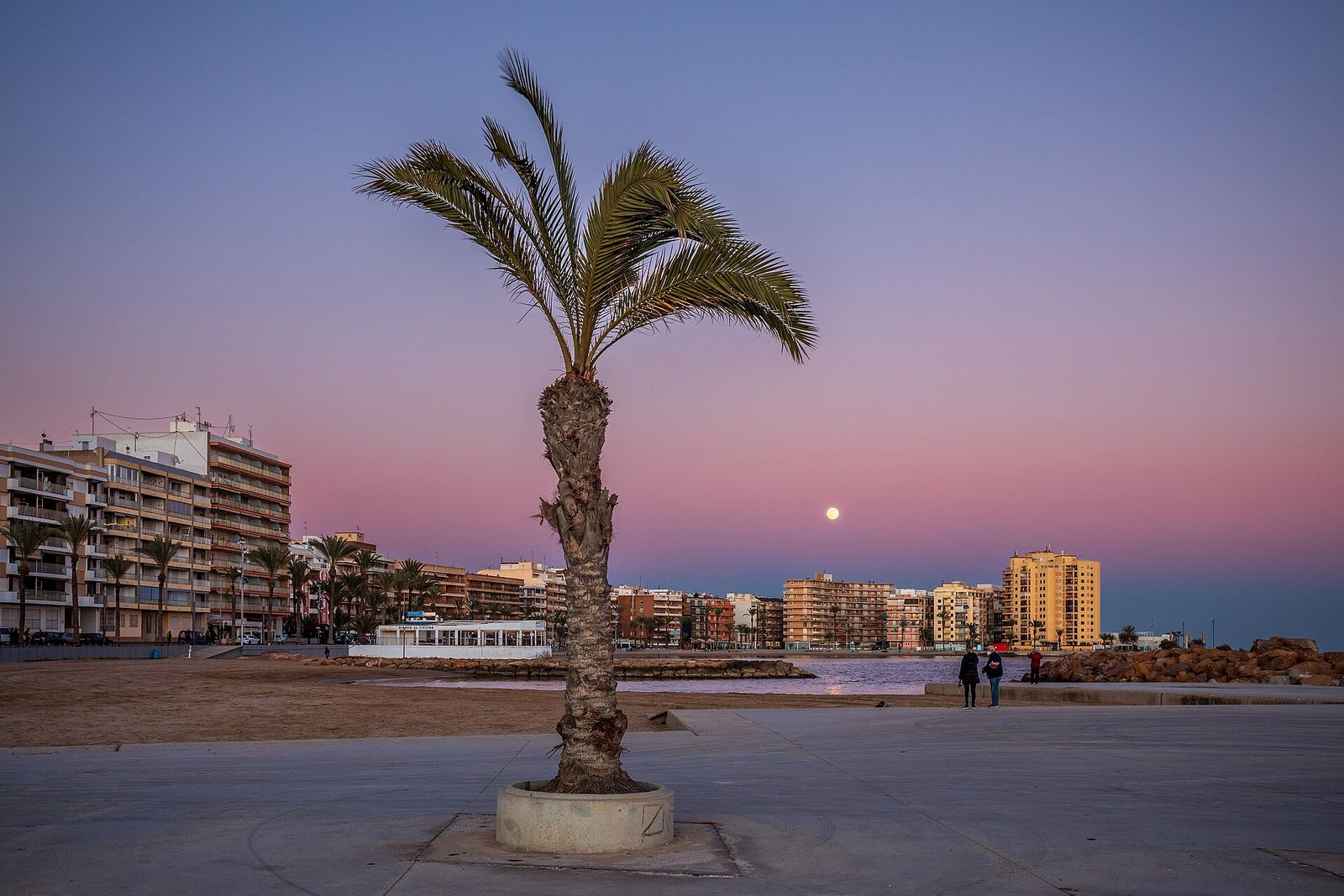
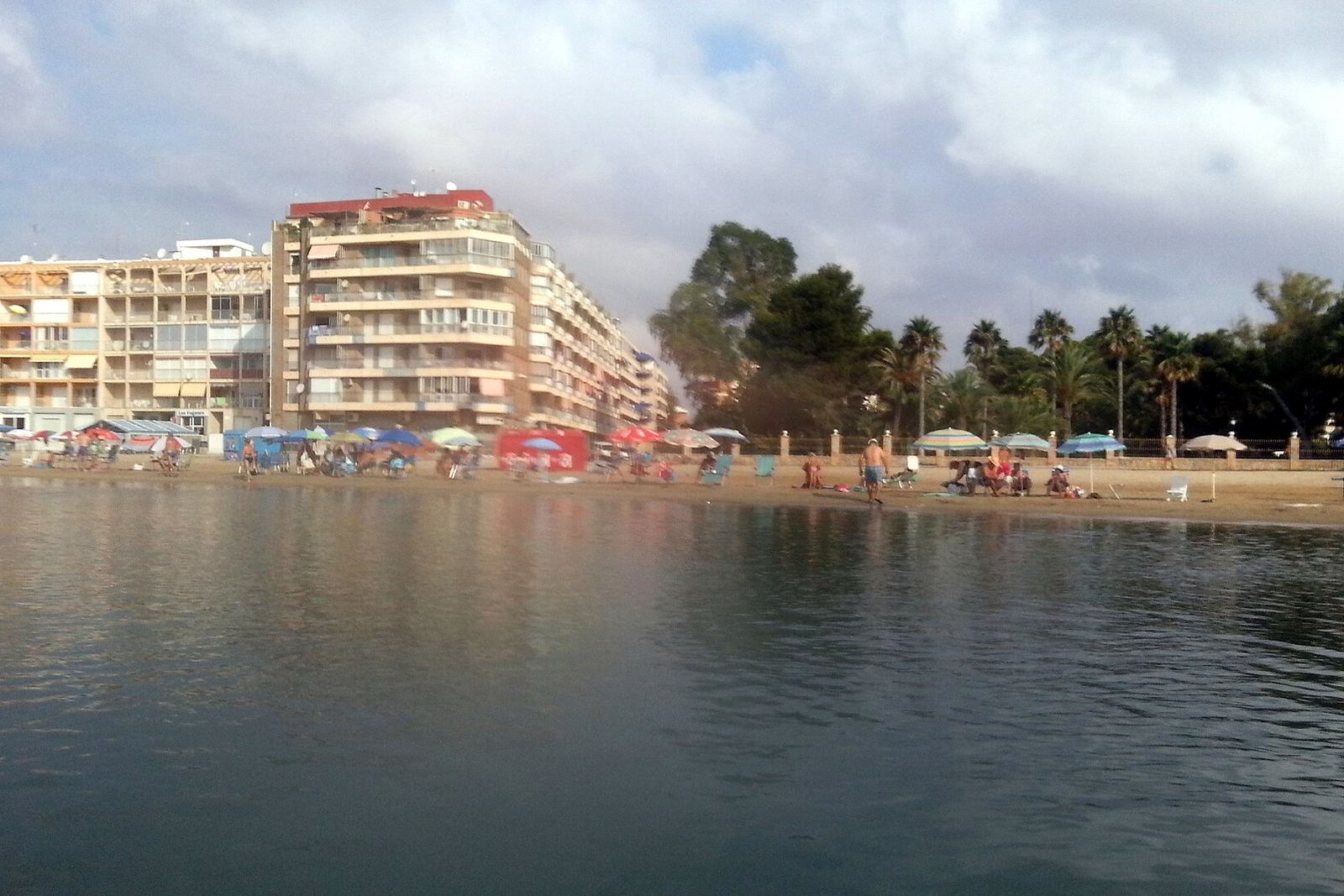
The town is flat — about seven metres above sea level — and covers 71.8 km², with roughly 20 km of coastline. The centre is built densely and right up against the sea: mid- and high-rise apartment blocks start immediately behind Playa del Cura and Playa de los Náufragos. That is a real trade-off, not a detail — anyone expecting a low pine-and-dune shoreline has to look a few kilometres north to La Mata, or to neighbouring Guardamar del Segura.
The town's social spine is the Paseo Vistalegre, a shaded promenade of restaurants and ice-cream parlours laid out in 1842 as the Paseo del Malecón, linking the fairground, the port and the urban beaches; the Monument to the Choristers stands on it, a nod to the town's habanera heritage. A marina flanks the fishing harbour on either side — Marina Salinas with about 724 berths and the Club Náutico Marina Internacional with 859 — and the fishing fleet, though small, still goes out.
At the heart of the old town is the Eras de la Sal, the 18th-century salt-loading dock in use from 1777 to 1958 and restored from 1997. Every July it hosts the international habanera and polyphony contest, held here since 1955. Everyday shopping is covered by the Centro Comercial Habaneras (60-plus shops, opened 2005) and the Friday market on Avenida Delfina Viudes.
There is no train: the old Alicante–Murcia branch line closed in the late 1970s and reopening remains an unconfirmed proposal. You get around by bus — 13 urban routes — or by car, on the AP-7 and the N-332. This is not a quiet Spanish pueblo: you hear several languages on any street, and the pace is that of a year-round resort.
The town's own padrón recorded 110,500 residents on 1 January 2026, of whom 59,205 — 53.6% — held a foreign nationality, from 123 countries. A council update in May 2026 put the total at 113,453. Treat the number carefully: the national statistics institute INE runs a materially lower series — 94,803 in 2024 — and that gap is a known feature of Costa Blanca towns with large foreign populations. Both series point the same way; they disagree on the level.
The five largest foreign communities are Ukrainian (10,074), Russian (5,746), Colombian (5,550), British (4,643) and Moroccan (3,525), with smaller Swedish, Romanian and Chinese groups. The mix has shifted fast: as recently as 2022 there were fewer than 3,000 Ukrainians and the British were the largest foreign group. The growth of the Ukrainian community is a direct consequence of the 2022 war, not the older retirement migration that brought the British and Russians here. In the latest year-on-year data, both of those communities have shrunk slightly.
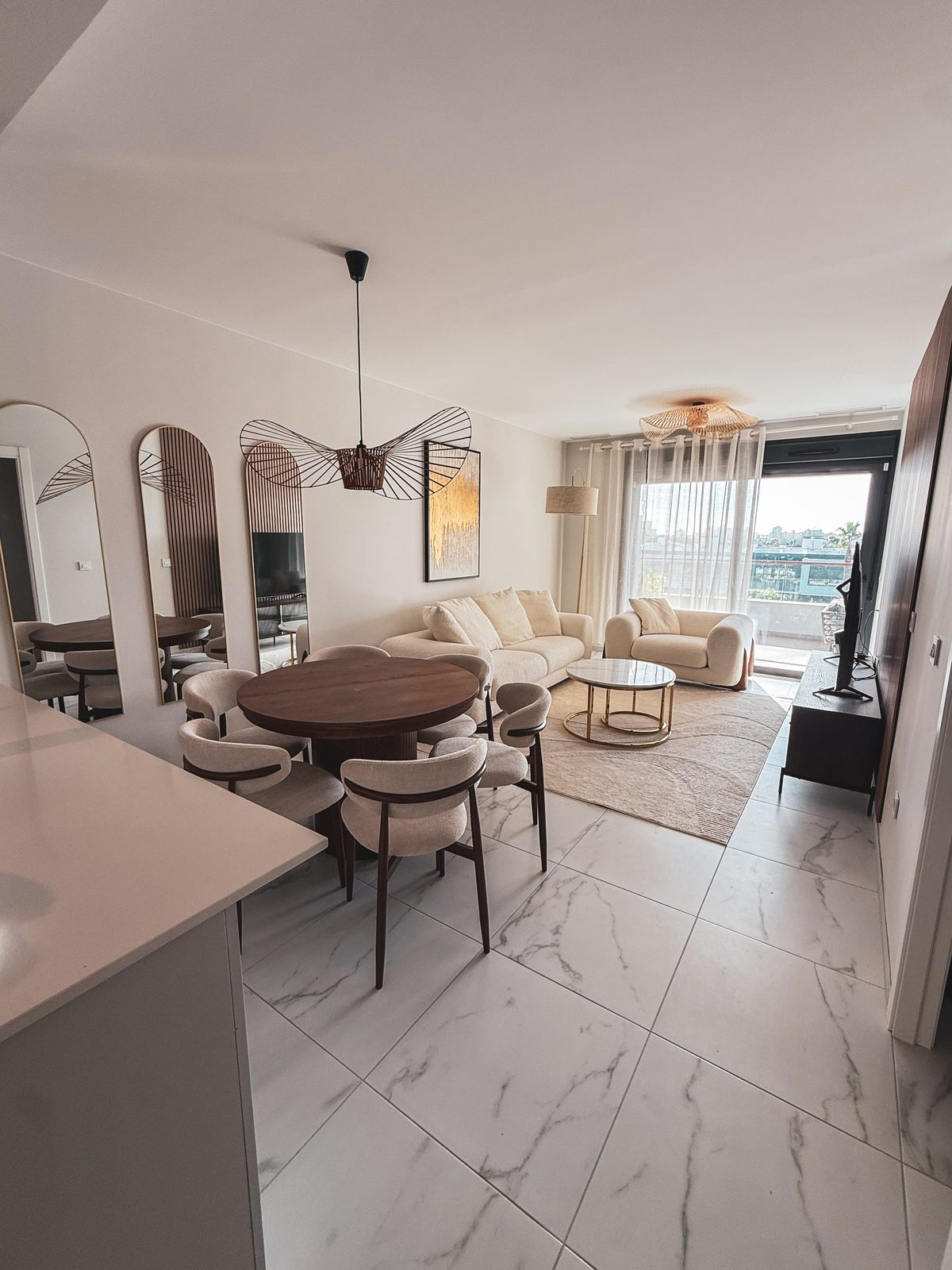
Small one- to three-bedroom apartments in mid-rise blocks dominate the central seafront and El Acequión. La Mata and Los Balcones add a substantial stock of bungalows and villas on individual or shared plots. Los Balcones is one of the province's longest-established second-home areas, about 3 km southwest of the centre, near the Villamartín and Las Ramblas golf courses.
Prices have risen sharply of late, but by how much depends on the source. The Fotocasa index put the average asking price at €3,183/m² in July 2026, up 27.5% year-on-year for homes over 100 m². A figure attributed to Idealista for the same spring (April 2026) is considerably lower at €2,502/m², and our research could not confirm it from the source directly. Both are asking-price indices, not registered sale prices. No single price per square metre should be read as exact; on direction, every source agrees it is up.
The salt lakes and La Mata
Two lagoons are wedged between the town and the fields inland: the pink-tinted Laguna de Torrevieja (about 1,400 ha) and the greener Laguna de La Mata (about 700 ha). Since 1989 they have been protected together as a Comunitat Valenciana natural park of roughly 3,700 ha. The pink comes from the salt-tolerant alga Dunaliella salina and the brine shrimp Artemia salina, which live in water as salty as the Dead Sea. Swimming in the lagoon is not officially permitted, but there is a visitor centre near La Mata with marked routes. The distance between the high-rises and genuinely quiet countryside here is a walk.
La Mata itself is a separate place, not just an address. This former salt-mining settlement in the north of the municipality is lower and quieter than the centre: its own 2,300-metre beach behind pine-covered dunes and the Parque del Molino del Agua, its own Wednesday market and an 1896 parish church. Only about 1,260 residents were registered in the formal pedanía in 2019, but that badly understates the real resident and holiday-home population.
Who Torrevieja suits — and who it does not
Retirees
The terrain is flat — the town sits about seven metres above sea level — and a lot is walkable. There is a public hospital, the Hospital Universitario de Torrevieja, and a private one, Quirónsalud, and English and Russian genuinely work day to day.
Short-let investors
The Comunitat Valenciana has a working, registrable short-let licence (vivienda de uso turístico), and the demand is measured rather than hoped for: the town's own water data put about 460,000 people present at the August 2024 peak.
Buyers who want a ready-made international support network
Residents come from 123 countries and the foreign share is above half. With that comes infrastructure smaller Costa Blanca towns do not have: English-speaking healthcare, gestores and agents who have been doing this for decades.
Who Torrevieja does not suit
Anyone after a quiet, low-rise Spanish fishing village should look at Guardamar del Segura or the northern edge of La Mata instead. There is no international school in the town — the nearest, Phoenix International School, is in Villamartín, about 10 km away.
Ask before you fly out
We speak Estonian and Russian, and we know how a central apartment block differs from a bungalow in La Mata. Tell us what you are looking for and we will say honestly whether Torrevieja is the right place for it.
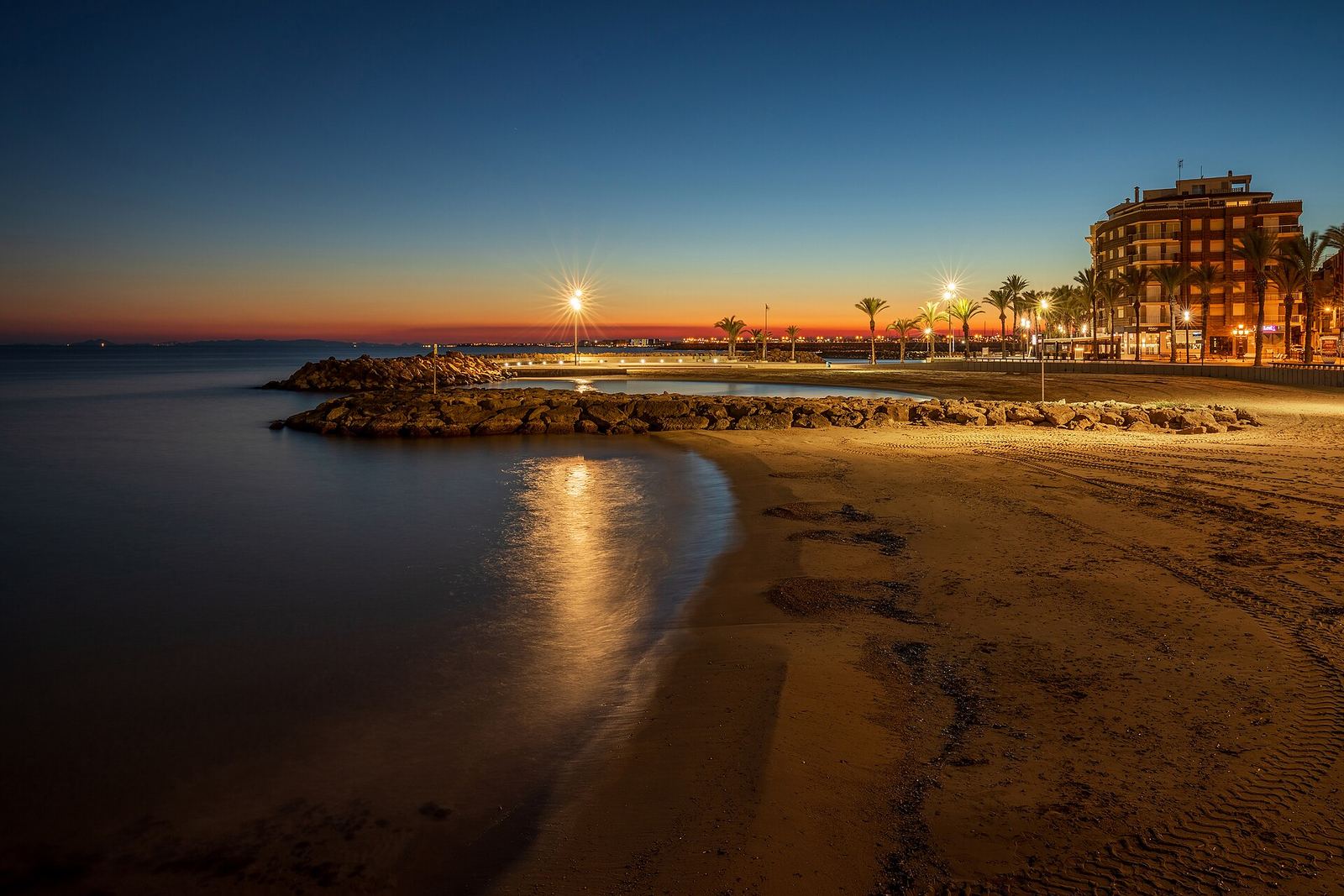
About 20 km of coastline, six Blue Flags: Playa del Cura, Playa de los Locos, Playa de los Náufragos, Cabo Cervera, Cala Piteras and La Mata-Sur
Hospitals and health centres
Hospital Universitario de Torrevieja (public) and Quirónsalud Torrevieja (private, La Loma); health centres at La Loma, El Acequión, La Mata and Patricio Pérez / San Luis
International school
None in the town; the nearest is Phoenix International School in Villamartín, about 10 km away
Market day
Fridays 8am–2pm on Avenida Delfina Viudes; Wednesdays in La Mata
Marinas
Marina Salinas (about 724 berths) and the Club Náutico Marina Internacional (859 berths), either side of the fishing harbour
Golf
Villamartín (1972, about 16 km), Real Club de Golf Campoamor and Las Ramblas — about 10 minutes from the coast
Roads and rail
The AP-7 motorway and the N-332 coast road; no passenger rail, the nearest tram is in Alicante. 13 urban bus routes, plus Avanza and ALSA long-distance services
Property in Torrevieja
Everything currently available in our feed. The list refreshes nightly.
No. Unlike purely seasonal resorts, much of the town's foreign population is registered and lives here year-round, so shops, health centres and the Friday market stay open through winter. It does get dramatically quieter: the council's culture department describes the population as quintupling in summer. Restaurants switch to off-season menus and pricing rather than closing.
How far is the nearest airport?
Alicante-Elche (ALC) is the nearest commercial airport — about 44 km and 40 minutes by car. Región de Murcia airport at Corvera (RMU) is about 59 km and 55 minutes. The town's own tourism site still advertises "30 minutes to San Javier airport": the distance is right, but San Javier has had no scheduled commercial flights since January 2019, when Corvera replaced it.
Can I let my apartment out short-term?
Yes, but it has to be registered. In the Comunitat Valenciana a holiday let must be entered in the regional tourism register as a vivienda de uso turístico. That needs a declaración responsable, a municipal report confirming the building may be used for tourist purposes, and a valid occupation licence. The whole property must be let — room-by-room is banned. Ley 9/2024, in force since 8 August 2024, tightened the rules.
Can you manage at the hospital and the shops without Spanish?
Day to day, mostly yes: more than half of registered residents are foreign nationals, and English and Russian are genuinely in use. The town has the public Hospital Universitario de Torrevieja and the private Quirónsalud, which treats about 120,000 patients a year, nearly half from outside Spain. Official business and health centre paperwork still run in Spanish, so budget for a gestor.
Is the Torrevieja lake really pink, and can you swim in it?
Yes. The Laguna de Torrevieja is a working salt-production lagoon rather than an attraction, and the pink tint comes from the alga Dunaliella salina and the brine shrimp Artemia salina. Swimming is not officially permitted, but there is a visitor centre near La Mata with marked routes.
Do you need a car here?
In the centre, not necessarily: the terrain is flat, the promenade, beaches, shopping centre and market are within walking distance, and there are 13 urban bus routes plus Avanza and ALSA long-distance services. There is no passenger train — the old branch line closed in the late 1970s. If you buy in Los Balcones, La Mata or near the golf courses, a car is effectively compulsory.